27 Countries, Over 200 Participants, One Shared Agenda: River Basins, Estuaries and Coastal Zones
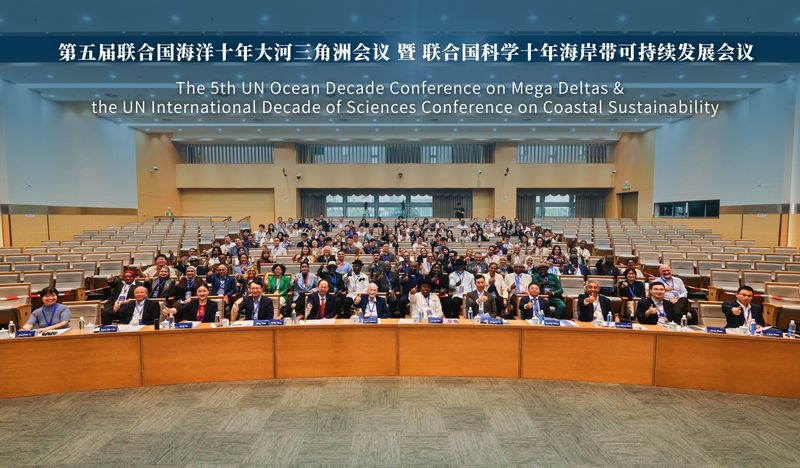
October 18-21, 2026 - The 5th UN Ocean Decade Conference on Mega Deltas, held jointly with theUN Decade of Sciences for Sustainable Development Symposium on Coastal Sustainability, in East China Normal University (ECNU), Shanghai. More than 200 experts, scholars, enterprise representatives and members of international organisations from 27 countries — including France, Germany, the Netherlands, Norway, Russia, Spain, Croatia, the United States, Brazil, Uruguay, Nigeria, Tanzania, Egypt, Namibia, Ghana, Morocco, Tunisia, Mauritius, Comoros, Bangladesh, Thailand, Viet Nam, Pakistan, Turky, Iran, Malaysia and China — gathered to address the theme of “Evolution and Governance of River Basin–Estuary–Coastal Zone Systems”. Participants exchanged frontier scientific findings, shared governance experiences and innovative practices, and explored scientific pathways and international cooperation mechanisms for the sustainable development of mega deltas and coastal zones.
The opening ceremony was chaired by Prof. Lijun Hou, Director of the State Key Laboratory of Estuarine and Coastal Research, East China Normal Univeristy.
Governor Douye Diri of Bayelsa State, Nigeria, attended with a delegation and delivered opening speech. Drawing on the practical needs of delta and coastal zone governance in Bayelsa State, he shared his reflections on global partnerships, inclusive participation of stakeholders, and bottom-up policy support for the UN Convention on River Delta (UNCRD) initiative. He stressed the importance of strengthening multi-party collaboration and of linking local governance practice with policy-making, offering a local-practice perspective for deepening international exchange on mega delta and coastal zone governance.
Prof. Haibo Yang, Director of the Science and Technology Department of ECNU, then delivered a welcome address on behalf of the University. He noted that ECNU, rooted in Shanghai on the banks of the Yangtze River, enjoys the distinctive geographical advantage of being connected to both the river and the sea. The University will give full play to its comprehensive strengths in the coordinated development of the humanities, sciences and engineering, continue to deepen international exchange and cooperation, and actively build high-level platforms for academic exchange and collaborative innovation. He expressed the hope that ECNU and the State Key Laboratory of Estuarine and Coastal Research will strengthen exchange and deepen cooperation with experts, scholars, government administrators and business representatives from different river basins and estuarine and coastal regions, jointly exploring new pathways for land–sea coordination and the sustainable development of coastal zones.
Specially invited experts delivered keynote lectures. Academician Louis Legendre from Sorbonne University, France, presented the functioning of ocean carbon pumps and their significance. Prof. Kam-biu Liu from the Chinese University of Hong Kong described environmental changes in the Mississippi River Delta over the past 5,000 years. Prof. Zhengbing Wang of Delft University of Technology, the Netherlands, presented research on sediment management in the Dutch tidal basins. Prof. Qing He from ECNU examined the reversal of the source–sink relationship of sediments within the Yangtze River basin–lake–estuary system. The keynote lectures covered the latest advances in marine biogeochemistry, palaeoenvironmental evolution and sediment dynamics, demonstrating the multidisciplinary character of research on mega deltas and coastal zones.
The conference featured seven thematic sessions addressing key scientific and governance questions facing mega deltas and coastal zones worldwide: (1) delta evolution under climate change and human activities; (2) integrated river basin–estuary–coastal zone systems and land–sea coordinated governance; (3) coastal ecosystem conservation, restoration and the blue economy; (4) climate change adaptation, disaster risk reduction and resilient coastal construction; (5) estuarine waterway engineering and technology application; (6) sediment dynamics in rivers, estuaries and nearshore waters; and (7) China–Africa cooperation on large river basins and coastal sustainability. Within the framework of the UN Ocean Decade and the UN Decade of Sciences for Sustainable Development, the conference promotes the alignment of scientific research, governance practice and policy needs through interdisciplinary and transregional exchange, providing a platform for exploring coordinated governance pathways for mega deltas and coastal zones.
Mega deltas and coastal zones are vital links between river basins and the ocean, bearing on ecological security, economic development and human well-being. As the impacts of climate change and human activities intensify, the sustainable development of mega deltas and coastal zones is of great significance for addressing climate change, safeguarding ecological security and achieving the UN Sustainable Development Goals. Notably, the sustained efforts of Chinese research teams in global coastal science and sustainable governance have injected new momentum into international scientific cooperation, demonstrating China’s sense of responsibility in actively participating in and helping to shape global coastal governance and in advancing sustainable development.
Participants look forward to using science as a bridge and cooperation as a bond to deepen mutual learning, build consensus on development, transcend geographical and disciplinary boundaries, jointly address the challenges facing mega deltas and coastal zones, and explore pathways of sustainable development in which humanity and nature live in harmony — together painting a brighter picture of globally prosperous coastal development.